


Vietnam Riverine Craft 1962-75
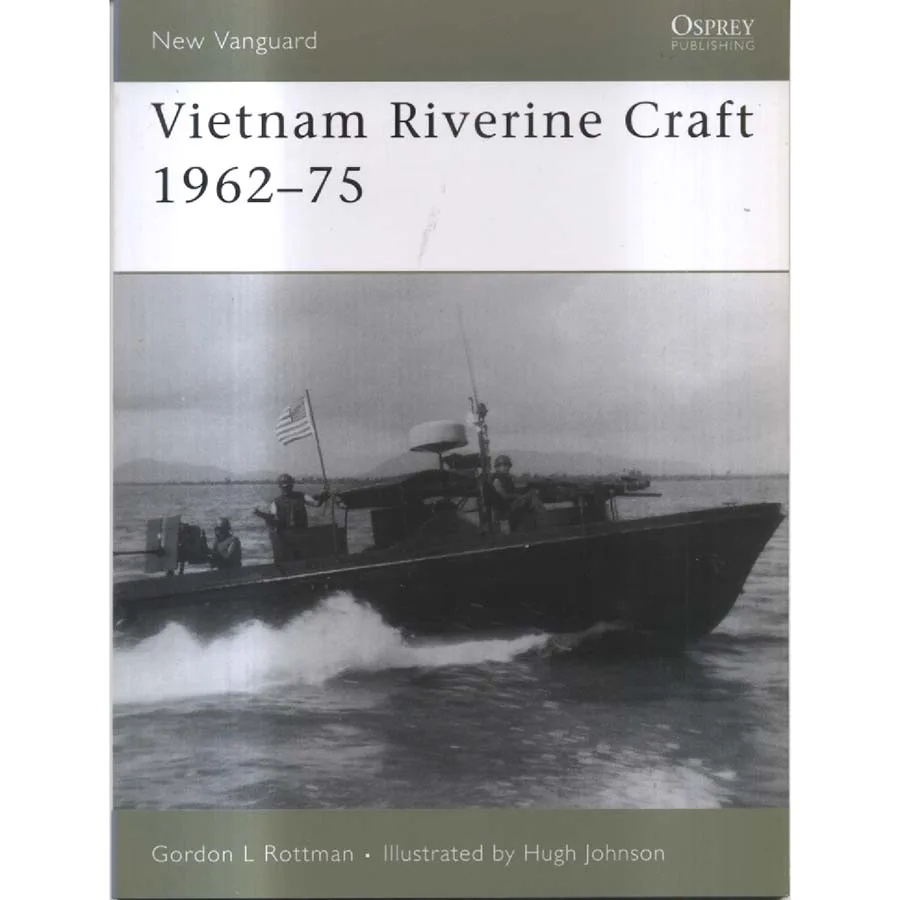
Publisher: Osprey Publishing
Format: Paperback
ISBN: 9781841769318
Vietnam Riverine Craft 1962–75 is the story of what happened when the United States looked at the swamps, canals and tangled waterways of Vietnam and decided that the land war would be improved by adding boats with machine guns.
The Mekong Delta contained thousands of miles of rivers and man-made canals but relatively few useful roads. For generations, boats had been the practical means of moving people and goods through the region. The Viet Cong understood this perfectly, using the waterways and surrounding terrain to move fighters, weapons and supplies. The American response was the “brown-water navy,” a river force designed to patrol, transport troops and deliver substantial quantities of firepower into places where ordinary warships would have become expensive pieces of stationary scenery.
In 1965, worsening conditions in the Delta led to the creation of the joint Army–Navy Mobile Riverine Force. Its land component came from the US Army’s 2nd Brigade, 9th Infantry Division, while River Assault Flotilla One supplied the boats and sailors. It was an unusual partnership in which soldiers went to war aboard naval craft and sailors found themselves fighting at ranges where the opposite bank was uncomfortably close.
Gordon L. Rottman examines the remarkable collection of vessels developed for this purpose. Some were purpose-built patrol boats; others began life as landing craft before being enclosed in armour, fitted with turrets and burdened with enough weapons to suggest that subtlety had been considered and rejected. The resulting machines included armoured troop carriers, assault support patrol boats, command boats, refuelling craft and monitors—the last named after the famous Civil War ironclad and resembling a floating bunker assembled by somebody with access to a naval scrapyard and no fear of excess.
The armoured troop carriers delivered infantry directly to hostile riverbanks, combining the functions of transport, landing craft and conspicuous target. Monitors carried heavy guns, grenade launchers and machine guns to provide close support. Assault support patrol boats guarded formations and searched for mines, while command and communications craft attempted to impose order upon a situation involving narrow waterways, dense vegetation, hidden enemies and numerous heavily armed boats manoeuvring in close proximity.
Patrol Boat, River craft and Swift Boats conducted patrols, inspections and interdiction missions, seeking vessels carrying arms and supplies. Every innocent-looking sampan required investigation, every river bend might conceal an ambush, and every stretch of bank offered excellent cover to anyone with a rifle or rocket-propelled grenade. Unlike service on an ocean-going vessel, riverine warfare rarely allowed the crew the comfort of believing the enemy was several miles away.
Rottman describes not only the craft and their variants but also how they were employed in combat. The Mobile Riverine Force used the waterways as moving highways, bringing infantry and fire support rapidly into contested areas. The book also covers Task Force Clearwater, the smaller river operation protecting vital waterways in the northern part of South Vietnam, because apparently the southern rivers had not provided enough administrative complexity.
The designs are fascinating examples of wartime improvisation. Armour had to protect crews without making vessels too heavy for shallow water; weapons needed wide fields of fire without shooting neighbouring boats; engines had to survive mud, weeds and damage; and every modification produced additional weight demanding another modification. The finished craft were rarely beautiful, but beauty was not included in the operational requirement.
This is number 128 in Osprey’s New Vanguard series, presented in the familiar concise and heavily illustrated format. Across 48 pages, Rottman supplies technical descriptions, operational history, surviving examples and variant details, accompanied by photographs and seven colour illustrations by Hugh Johnson. It is ideal for naval historians, Vietnam specialists, military modellers and readers who believe an ordinary landing craft can always be improved by welding a small fortress onto it.
This copy is in As New condition, appearing unread and showing no evidence of having navigated a canal, struck a submerged obstacle or attracted hostile fire from either bank. Sold by Crappy Old Books, whose own brown-water capability is limited to carrying parcels through the rain without allowing the cardboard to dissolve.
Keep browsing: See more War books Other books by Gordon L Rottman
